Career Assessment for Teenagers: A Guide for Counsellors, Coaches & Educators
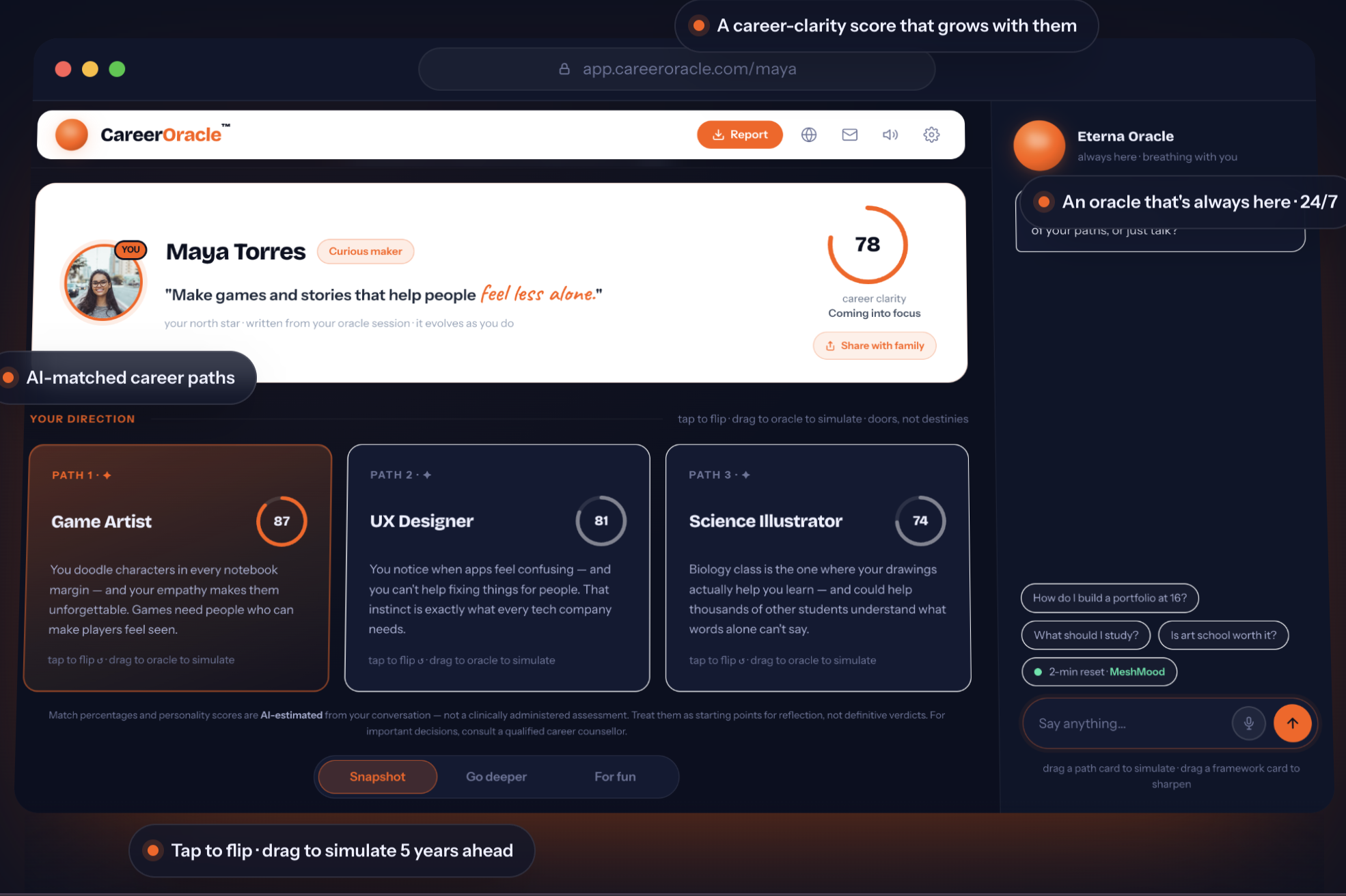
The tools that career counsellors, coaches, and educators have relied on for decades were designed for a different world — one where the job market was more stable, career paths were more linear, and the average teenager had a more homogeneous experience of education and work.
Gen Z is different. They've grown up with non-linear information, are more likely to have side projects or online audiences than part-time jobs, and are acutely aware of the volatility of the job market they're entering. Assessment tools that worked well for their parents often miss them entirely.
This guide covers what the research says works for teenage career development, where AI fits in professional practice, and how CareerOracle is designed specifically to work alongside — not instead of — practitioners like you.
Why Traditional Assessments Often Miss Gen Z
Most widely-used career interest inventories were normed on adult populations, often from the 1970s through 2000s. They were designed to reflect a job market that no longer exists in the same form. When a 16-year-old answers questions about whether they'd prefer to "supervise a factory floor" or "write a policy brief," they're often answering about abstract concepts they have no felt experience of.
The other common limitation: disengagement. Paper-based or web-survey assessments ask teenagers to sit still and self-report with high precision on questions they often lack the life experience to answer. Engagement drops, introspection suffers, and the result is a profile built on guesswork.
The breakthrough moment in assessment often isn't a question — it's a conversation. When teens are asked to describe a real experience ("tell me about a time you couldn't stop working on something"), they access felt knowledge that a self-report item can't reach. This is why conversational formats consistently outperform surveys for teenage populations.
The Frameworks With the Strongest Evidence Base
The research case for using multiple frameworks simultaneously is strong. A teen whose RIASEC profile, Big Five scores, and Ikigai exploration all point in the same direction has a much more robust signal than any single instrument can provide.

Where AI Fits in Your Practice
AI doesn't replace the practitioner. What it can do — when well-designed — is handle the intake layer that currently consumes disproportionate session time. A structured AI conversation can surface in 15 minutes the kind of material that might otherwise take two or three sessions of rapport-building to reach.
A practitioner workflow using CareerOracle
Join the CareerOracle Coaching Marketplace
✦ Reach Teens and Families Who Are Ready for Guidance
CareerOracle is building a network of verified coaches, career counsellors, and educators who work with teenagers. After a teen completes their oracle session, they receive their career profile — and often, for the first time, they're genuinely motivated to go deeper. That's when they're most ready for professional support.
As a marketplace partner, you're introduced to teens and families at exactly that moment. You come in with context — their profile — so your first session is already more productive than most practitioners' third.
We're currently onboarding our founding cohort of practitioners. If you work with teenagers on career, identity, or life direction — as a school counsellor, private coach, psychologist, or educator — we'd like to hear from you.
Get in touch: hello@careeroracle.app
✦ Try CareerOracle Yourself First
The best way to understand what your clients will experience is to go through the oracle yourself. See the profile it generates, explore the career paths it surfaces, and decide how it fits into your practice.
Experience the Oracle →