The Hidden Cost of Student Dropout — and How to Fix It Before It Starts
Every year, schools and universities around the world watch students walk in with ambition and walk out without a degree. The dropout problem is framed almost universally as an academic one — grades, attendance, financial hardship. The solution is always the same: tutoring programmes, bursaries, counselling services.
These interventions are not wrong. But they treat the symptom. The root cause of most preventable dropout is something far upstream: a student who chose a path that was never really theirs.
Career misalignment — enrolling in a programme that does not match who you actually are — sets off a chain reaction that ends in disengagement long before it ends in formal withdrawal. And institutions are paying for it at scale.
The Numbers Are Impossible to Ignore
A mid-sized university with 15,000 students and a 25% dropout rate is losing the equivalent of 3,750 student-years of tuition annually. At £10,000 per year per student, that is £37.5 million in revenue that never materialises — from students who arrived, enrolled, and then left.
And that is only the tuition. The operational cost of processing enrolments for students who will not complete, the pastoral time spent trying to retain them, the reputational damage to completion-rate rankings, the impact on league-table positions — none of that is in the headline number.
A student who drops out in Year 1 typically does so after one or two full semesters. The institution has already spent on induction, admin, accommodation support, and early-year pastoral resources — with zero return. For postgraduate programmes, the sunk-cost window is even smaller.
Completion rates are increasingly used as a quality indicator by funding bodies, accreditors, and rankings compilers. A sustained dropout problem does not just cost money — it costs ranking positions and, in some jurisdictions, funding allocation.
Why Students Really Leave — and It Is Not What You Think
Exit surveys consistently show financial pressure as the most commonly cited reason for leaving. Institutions respond with bursaries and emergency funds. But financial hardship rarely causes dropout in isolation — it accelerates a withdrawal decision that was already forming.
When students describe why they lost motivation, the answers converge on something different:
- "I realised this was not the right course for me."
- "I did not know what I wanted to do with it."
- "I could not connect what I was studying to any future I could actually see."
- "I felt like I was doing what was expected, not what I actually wanted."
This is career misalignment. The student arrived without a clear, self-grounded understanding of who they are, what they are drawn to, and what kind of future could actually excite them. They made an enrolment decision based on predicted grades, parental pressure, peer choices, or a vague idea of what sounded respectable.
And institutions, with the best of intentions, accepted that decision and asked no further questions.
Studies across the US, UK, and EU consistently find that students with a clear career intention at enrolment are significantly less likely to drop out — not because they are more academically capable, but because they have a reason to push through difficulty. Motivation, not ability, is the primary protective factor against dropout.
Career intention is not the same as career certainty. Students do not need to know exactly where they will end up. They need to understand themselves well enough to have a genuine sense of direction. That is what most pre-enrolment processes fail to build.
Where Current Systems Fall Short
Most secondary schools have some form of careers guidance. Most universities have a careers service. The gap is not one of provision — it is one of depth and timing.
| System | What it provides | What it misses |
|---|---|---|
| Secondary school careers adviser | General subject-to-career mapping, UCAS support | Individual personality profiling; too many students per adviser to go deep |
| University open day | Programme information, campus tour | Any exploration of whether this is the right fit for this specific person |
| University induction week | Social integration, module information | Career grounding — the question of why this student chose this path |
| University careers service | CV support, job boards, employer events | Arrives too late — typically engaged in Year 2 or 3, after the decision to stay or leave is already made |
| Standardised career assessments (Holland, MBTI) | Single-framework trait mapping | Shallow profiling; normed on adult populations; poor engagement with under-18s |
The common thread: by the time a student is in crisis, the window for deep intervention has passed. Meaningful career grounding needs to happen before enrolment — or at the very latest, in the first weeks of Year 1.

The Intervention That Actually Works: Self-Knowledge Before Commitment
The highest-leverage moment in a student's educational journey is not when they are struggling in Year 2. It is the six-month window before they make their enrolment decision — and the first few weeks after they arrive.
This is when identity is most in play. Students at 16–18 are actively constructing who they are. They are more open to self-reflection than at any other point in their educational career. And they have not yet committed resources, time, and identity to a path that may be wrong for them.
What they need is not more information about careers — there is more career information available online than any student could ever process. What they need is a structured process for understanding themselves: their personality architecture, their operating mode, where their energy goes, what their natural strengths are, and how those map to real career territories.
"A student who understands themselves does not need to be retained. They stay because they chose correctly."
How CareerOracle Works in an Institutional Context
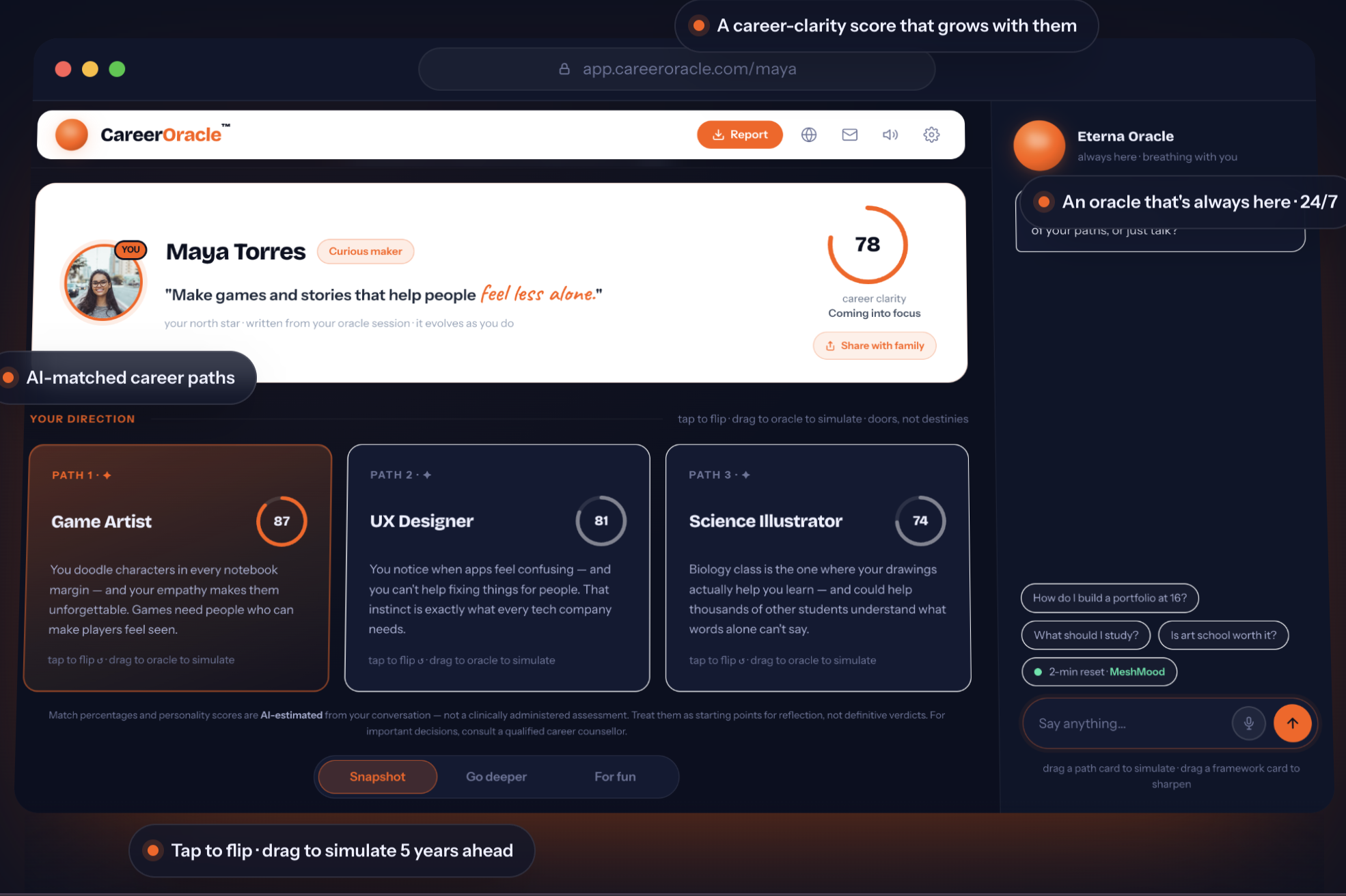
CareerOracle is a 15-minute AI-led voice conversation that produces a complete career profile — Big Five personality traits, RIASEC vocational profile, Ikigai convergence score, Jungian archetype, and three evidence-based career path recommendations with real O*NET occupational codes.
It was built for teenagers 14–18, which is exactly the population schools and universities need to reach before enrolment decisions are made.
The result is not a replacement for human guidance. It is the intelligence layer that makes human guidance dramatically more effective — because the adviser is no longer starting from scratch, and neither is the student.
Where Schools Deploy CareerOracle
Pre-enrolment programme (Y11–Y13)
Deliver CareerOracle as part of the careers curriculum in the two years before UCAS or vocational qualification choices are made. Students arrive at the decision point with a grounded self-portrait rather than a GCSE results sheet and a vague ambition.
University transition programme (pre-arrival or Week 1)
Offer CareerOracle as part of the pre-arrival experience or induction week. Students who can connect their new programme to a genuine understanding of their own profile are measurably more engaged in the first term — the period in which dropout risk is highest.
First-year academic advising integration
Academic tutors and personal advisers receive the CareerOracle profile alongside a student's academic record. Early warning of profile-programme misalignment — a student with low RIASEC Investigative scores enrolled in a pure sciences programme, for example — allows early, low-stakes intervention before disengagement sets in.
Widening participation & access programmes
Students from non-traditional backgrounds disproportionately lack access to the informal career guidance that their more privileged peers receive through family networks. CareerOracle levels that access — every student gets a rigorous, personalised career portrait regardless of what their parents do for a living.
Schools and universities that embed structured self-knowledge at the pre-enrolment or early-Year-1 stage report the same shift: students stop describing their programme as something that happened to them and start describing it as something they chose — because they actually did, with real self-understanding behind the decision.
That is the difference between a student who persists through difficulty and one who leaves at the first credible off-ramp. Career clarity is not a luxury. It is a retention strategy.
The Business Case in Three Lines
A 5-percentage-point improvement in first-year retention at a 15,000-student institution with a 25% dropout rate recovers approximately 188 student-years of tuition annually. At £10,000 per student-year, that is £1.88 million in revenue — from a single cohort year.
The cost of deploying CareerOracle across an entire incoming cohort is a fraction of that figure.
More importantly: the students who stay because they understand themselves are more engaged, perform better academically, and become the alumni who give back to the institution and recommend it to the next generation. Retention is not just a revenue problem. It is a reputation problem, a mission problem, and a student welfare problem.
CareerOracle is available for institutional licensing, pilot programmes, and curriculum integration. If you are a school, college, or university exploring how to embed structured career self-knowledge into your student experience, we want to talk. Contact us at hello@careeroracle.app with the subject line "Institutional Partnership".
We currently work with institutions on a flexible basis — from single-cohort pilots to full-scale enrolment integration. Every partnership is scoped to the institution's specific student success goals.
The Question Worth Asking
Your institution spends significant resource each year on marketing to attract students, on pastoral support to help struggling students, and on careers services to help final-year students find work. Each of these is a valuable investment.
But between attraction and struggle, there is a gap: the moment of enrolment, when a teenager makes a decision that will define the next three to four years of their life, often with less self-knowledge than they have opinions about what to watch on a Friday night.
What if you closed that gap? What if every student who arrived at your institution arrived knowing — with evidence, not guesswork — why they were there and where they were going?
The dropout rate is not a fixed feature of higher education. It is the measurable cost of a system that asks students to commit before they know themselves. The technology to fix that now exists. The question is whether institutions are ready to use it.
✦ See What CareerOracle Produces
Try the 15-minute oracle yourself — or share it with your students. See the full career profile that every young person leaves with.
Try CareerOracle Free → Institutional enquiries: hello@careeroracle.app